From Baudelaire to Threads, the people already inside have always had reasons to keep the door shut.
A message on Threads for “AI artists” caught my eye this week - “If we can’t handle being told our art sucks and that we should try harder”, it says, “we were never meant to be artists in the first place”. When I saw it, it had fourteen likes and eighteen replies, which on Threads counts as a standing ovation and a pile-on at the same time.
I won’t name the author. They’re hardly alone, and the sentiment hardly needs a figurehead these days. What interests me is the idea of art tucked inside it, which is that an artist is whoever can do the hard technical bit. Find a way round the hard bit and you’ve cheated, so go back to the start and try harder.
I write novels with AI, and I’ve never made a secret of it. The ideas are mine: the premise, the world, the people in it and what happens to them. The machines do a lot of the bricklaying, for example different models voice different characters, (but that’s for another post), and then I revise, more times than I’d care to admit. So when someone tells me to try harder, my honest answer is, harder at what? I already try quite hard. Just not at the part they’ve decided is the real work.
Einstein’s mathematician
Before anyone writes in: Einstein did not fail maths at school. That one’s a myth, and his report card shows top marks in algebra and geometry. But higher mathematics was never really his thing. Hermann Minkowski, who taught him in Zurich, later said the young Einstein had been a lazy dog who “never bothered about mathematics at all”.
So in 1912, when he became convinced that gravity was really the geometry of spacetime, he hit a wall. He knew what he wanted to say and didn’t have the maths to say it. He went to his old classmate Marcel Grossmann, by then a maths professor, and, as a friend remembered it, asked for help in words anyone who has been stuck on a deadline will recognise: “Grossmann, you must help me, otherwise I’ll go crazy!”
Grossmann found him the geometry he needed, and the two of them published the first sketch of general relativity together. Nobody now says Einstein cheated, or that he was never meant to be a physicist.
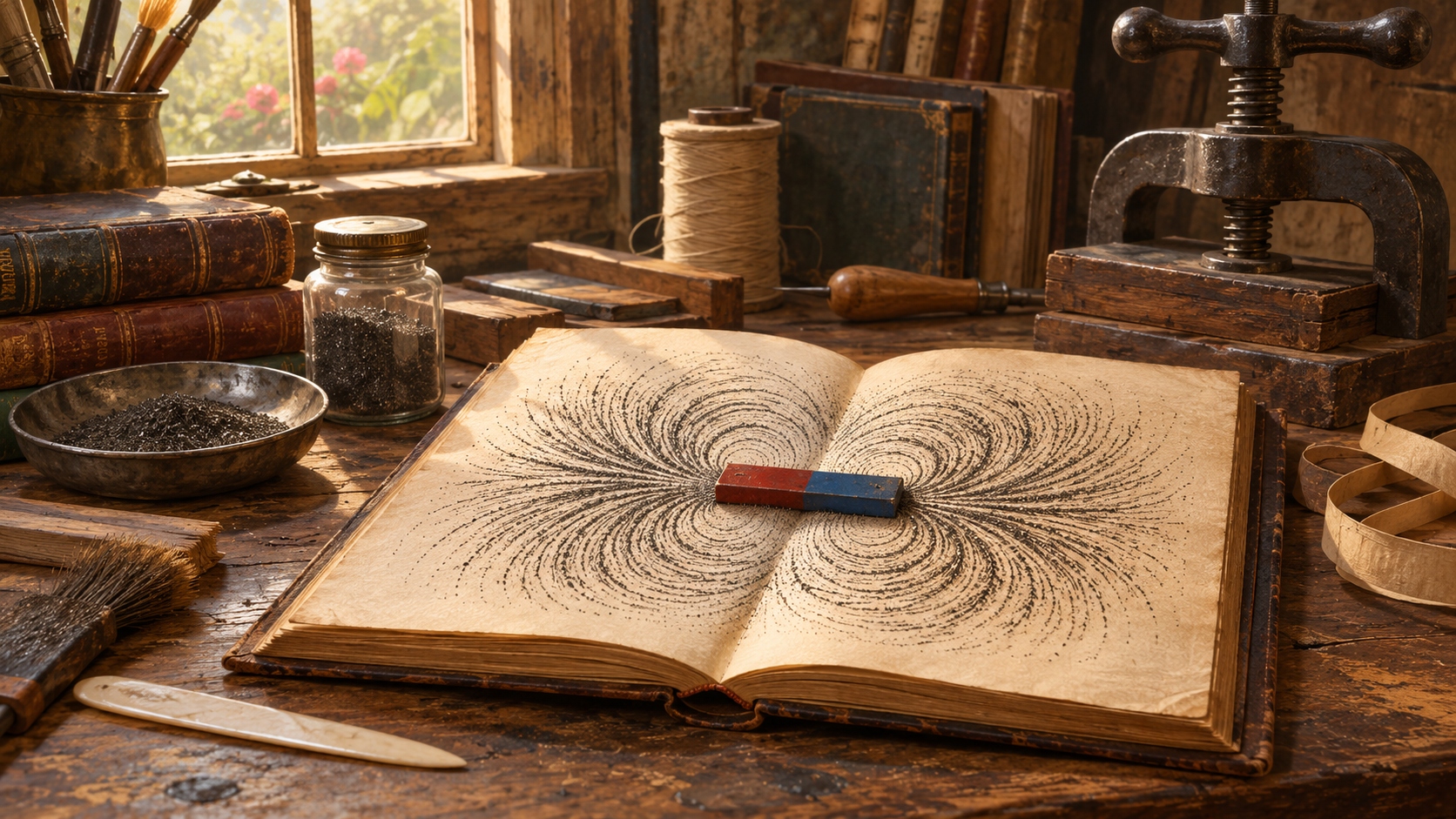
Faraday is an even better example, because he never got the maths at all. He was a bookbinder’s apprentice who taught himself science from the books passing through the shop, and he never learned any mathematics. He thought in pictures instead, imagining lines of force looping round a magnet, and it was left to James Clerk Maxwell to turn those pictures into the equations that eventually gave us radio.
Had someone told the young Faraday to try harder, he’d have been sent off to learn calculus first. I suspect he’d still be binding books.
The moat and the ladder
I don’t want to be glib about this. Plenty of people who make, or used to make, a living from illustration are watching the ground shift under their feet, and I’ve argued before that their questions about who profits deserve a proper hearing. “Never meant to be an artist” goes further than that, though. It’s about who gets through the door, and people have been saying it for a very long time.
In 1859, when the Paris Salon first let photographers exhibit, Charles Baudelaire called photography the refuge of every failed painter, too poorly gifted or too lazy to finish their studies. Swap “photography” for “AI” and you could post it on Threads this afternoon. (He did sit for the odd photographic portrait himself though.)
In 1982, after Barry Manilow toured Britain with synthesisers standing in for part of his orchestra, a branch of the Musicians’ Union passed a motion to ban synths and drum machines. Those same machines went on to underpin a good deal of the music made since.
My favourite, though, is Louisiana, which until 2024 made florists pass a state exam. For years that included arranging flowers in front of a panel of already licensed florists, which is to say the competition, and fewer than half the candidates got through. Since the state scrapped the licence, I’m not aware of any collapse in the quality of Louisiana’s bouquets.
The craft guilds of Europe were at it for centuries. The people already inside get to define talent as whatever they happen to have, and the definition always seems to involve the newcomer going back to the start. “Never meant to be” is the giveaway. It treats ability as something you’re born with, which is a very handy belief if you got in first.
The great equaliser
The most cheering thing I’ve heard on all this came from an unexpected corner. Maths has had a bruising year with AI. The machines have become formidable problem-solvers, and plenty of mathematicians are openly grieving. Grant Sanderson, who runs the 3Blue1Brown YouTube channel, has revived his podcast to talk it through, and his first guest was Steven Strogatz of Cornell.
Sanderson asks him what he’d tell a student who has loved maths all their life and now wonders whether they’re walking into a dead field. Strogatz, who admits he changes his mind daily, says it might actually be a wonderful time to go into maths, because AI could turn out to be a great equaliser.
His reasoning is that the price of entry used to be raw technical horsepower, the speed and stamina to follow long chains of reasoning. If you were technically average, you couldn’t play at the top, however good your instincts. Now the machine can grind through the proofs, and what counts is curiosity and taste. If you can ask the right questions, he says, “you’re in the game in a way that you never were before.”
That’s Faraday’s position, more or less. Sanderson goes a step further. A decade or so ago, he says, nobody would have accepted his kind of explanatory work as a maths PhD, but now that departments are having to rethink what a doctorate is, a student could make the case. He imagines a PhD where the student sets AIs loose to find thousands of results and then plays tastemaker, deciding what matters and making it make sense to everyone else. Strogatz loved the idea.
His own field offers a precedent. In the 1890s Henri Poincaré glimpsed the tangled structure at the heart of chaos, but declined even to try drawing it, and hardly anyone knew what he meant. It took the best part of seventy years, and the invention of computers, before people could see it. The idea was Poincaré’s all along; the computer simply let the rest of us in on it.
Strogatz is honest about the other side, too. Asked whether he’d have fallen for maths if a chatbot had handed him the answers as a teenager, he says no, he’d have missed out, which is fair enough. But nobody’s confiscating the struggle. He expects some mathematicians to refuse AI altogether, much as a novelist he knows won’t let it near his fiction, and that’s a perfectly respectable choice. It just isn’t a qualification the rest of us need before we’re allowed to start.
Harder at what
So, to the author on Threads: by all means tell me my book sucks. Bits of it probably do, and I’d honestly like to know which. That’s the deal when you put something out. “Never meant to be” is another matter. That’s a ruling on who’s allowed to make things at all, and the people who hand down rulings like that rarely look good in hindsight.
Strogatz, incidentally, says he’s more or less done writing books for the public after twenty-six years of it. He’d rather spend the time with his wife, Carol. They’ve taken to walking round the botanic gardens at Cornell photographing trees, then quizzing ChatGPT about them, because he can’t tell a spruce from a hemlock and the machine can. He calls himself a perpetual student. I know the type, though in my case the forest is imaginary and the machine mostly helps me remember which of my characters is which.