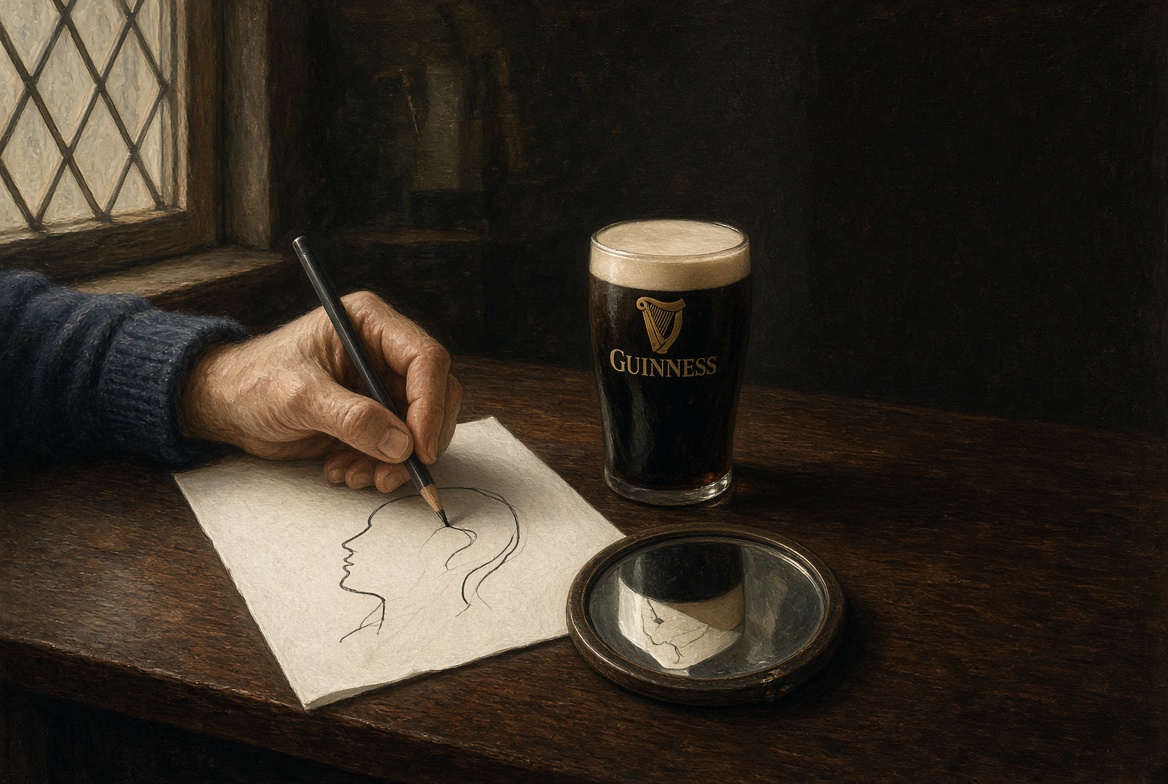
A pub napkin, a Dutch master and a mirror. What the fuss over AI provenance gets wrong about art.
When I was a child, my grandfather had a friend with what I thought was a very special gift. His name was George. He was a mild-mannered Scottish gentleman who had served in the navy, as had Grandad, and every now and again the two of them would meet up to shoot the breeze over a pint of Guinness.
I looked forward to those meetings, because George would sometimes practise his gift while they talked. He would take a paper napkin from the table and draw a portrait on it. His hand never seemed to leave the paper, and he was finished almost before he’d started. To a child watching from across the table, it was nothing short of sorcery.
George would have none of it. Call him an artist and he’d wave you away. I was too young to grasp the subtlety, but what he was drawing were silhouettes: a single confident outline of a face in profile. He was a draughtsman by trade, trained in technical drawing rather than art, and to his way of thinking what he did was something of a mechanical trick. He had an eye for curves and proportion, but presumably none of the shading and modelling he imagined a proper artist would need. I didn’t care how he did it. I watched a face appear out of nothing on a pub napkin, and as far as I was concerned that was art.
So the question of what qualifies as art had been rattling around my head for a long time when, some years ago, I watched a documentary called Tim’s Vermeer.
The film follows Tim Jenison, a Texan inventor who made his money in video technology, as he tests a hypothesis: that Johannes Vermeer, the seventeenth-century Dutch master whose interiors glow with an almost photographic light, painted with the help of optical devices. Arguing the point wasn’t enough for Jenison. He set out to paint a Vermeer himself.
It’s a fascinating film, and worth your time if you haven’t seen it. Fittingly, it was made by a pair of magicians, Penn & Teller, with Penn narrating and Teller directing. Jenison’s apparatus evolves from a simple camera obscura into something cleverer: a small mirror angled over the canvas, so that he can see the reflected subject and his own painting side by side, edge to edge. Where the colour in the mirror meets the colour on the canvas, he adjusts his paint until the join disappears. Line by line, the picture builds itself under his brush.
Along the way he brings in two guests who had already been through the wars on this subject: the painter David Hockney and the architect Philip Steadman. Both had published books in 2001 arguing that the old masters used optics, Hockney’s Secret Knowledge and Steadman’s Vermeer’s Camera, and both had caught it from art historians. Steadman recalls his book causing “deep anguish”, and critics casting him as an amateur and a crass rationalist trespassing on hallowed ground. As he saw it, the outrage rested on a misunderstanding about the nature of art, genius and cheating, and on the assumption that an optical method was somehow a cheat.
He points out that the alternative to optics was geometry. A painter without lenses could plot his perspective with rulers, string and vanishing points, and would never be accused of cheating. Both are tools, and both get you to the same place. Yet one is honoured as craft and the other treated as a confession.
Jenison is not a painter, and says so cheerfully. Over the five years the project took, he rebuilds the room from The Music Lesson in a warehouse in San Antonio, down to the furniture and the fall of the light, then spends more than 130 days painting it. The rug in the corner alone takes him the best part of a month. The result is an astonishing facsimile of a painting that hangs in the Royal Collection.
As a self-confessed AI evangelist, I sit firmly on the progressive side of this argument. Judge the book, not its cover.
Publishing is currently heading the other way. The fashion is provenance: keep your receipts. This very week, Library and Archives Canada began asking publishers who register an ISBN to declare that their book was written by a human author, with AI permitted for brainstorming, grammar and formatting. Substack has started labelling posts “Not scanned” when the writer switches off its AI detector. A publisher in Montreal caught out an author through the metadata in his files. Increasingly, the industry wants to see the workings before it will look at the work.
Look at where Canada drew its line. A grammar checker is fine. A brainstorming partner is fine. Generating the prose is beyond the pale. It’s Steadman’s geometry problem all over again. One tool counts as respectable craft and the other as a cheat, and the dividing line owes more to how each one feels than to anything that ends up on the page.
Curiously, the film touches on receipts too. It points out that Dutch painters of Vermeer’s day trained through an apprenticeship system that required them to document the techniques behind their work, as proof of that training. No such records of Vermeer’s have ever been found. Nobody knows where he trained, or with whom. Perhaps he threw away his receipts.
So was the camera obscura Vermeer’s AI? And if it was, is The Music Lesson any less beautiful for it?
It’s worth being clear about what the mirror couldn’t do. It couldn’t choose the room, pose the young woman at the virginal or decide where the light should fall across the floor. Jenison could copy all of that only because Vermeer had decided it first. The device did the matching. The eye that knew what was worth matching was Vermeer’s. That’s roughly how I think about a good prompt and a human who reads every word before anything goes out the door. The machine matches. The judgement is still yours, and it’s the judgement we ought to be scoring.
Thinking back to George, it strikes me as curious that he never thought his drawings were art, while I never doubted it for a second. Perhaps that’s because he was the magician. He knew the trick, and once you know how a thing is done it’s hard to see it as anything more than method. The audience doesn’t know, and so the audience gets the wonder.
Arthur C. Clarke put it best: “Any sufficiently advanced technology is indistinguishable from magic.” The more I learn about AI, the more magical it seems, which is odd, because under the bonnet it’s a mathematical trick. Predict the next piece of the pattern, then the next, at enormous scale. That trick now folds proteins, writes software and, yes, writes books.
Which brings me back to the magicians who made Tim’s Vermeer. Penn & Teller have built a career on showing audiences how the trick is done, and the curious thing is that the wonder survives the reveal. Knowing about the mirror doesn’t dim The Music Lesson in the slightest. Knowing it was a draughtsman’s trick never made George’s napkins any less of a marvel to me.
The provenance police want the magician to show his workings before they’ll admit there’s a picture on the paper at all. I’d rather look at the picture. Vermeer left no receipts, and I’ve yet to hear of anyone standing in front of The Music Lesson demanding to see them.
George never once called himself an artist. It took a child on the other side of the table to decide that, just by looking at what he’d made. All these years later, it’s still the only test I trust.