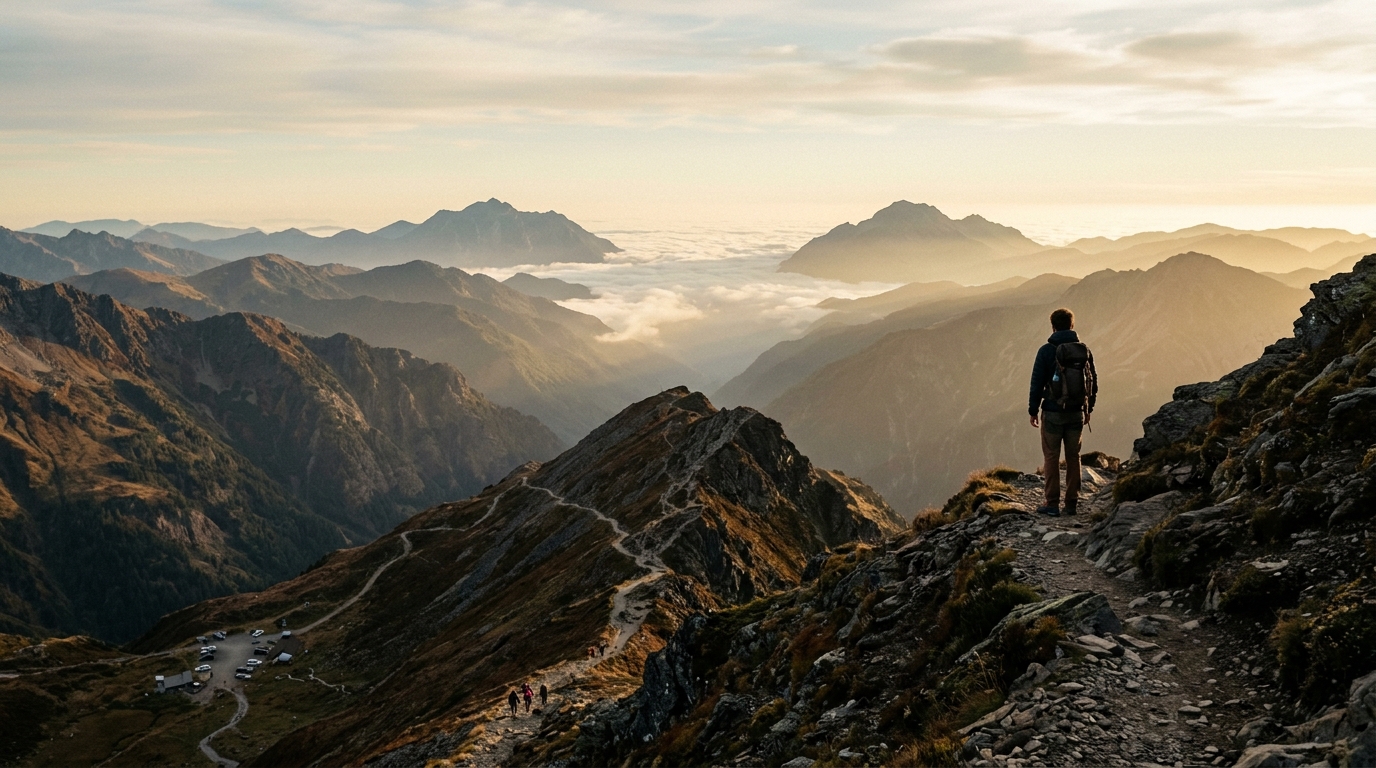
Mathematicians are further up the AI mountain than most of us, and what they’re seeing is worth hearing about.
I found myself responding to a comment on social media this week and in so doing, I came up with an analogy about AI which I thought merits a share on the old blog, so here we go.
Which comment I was responding to escapes me, as does the social media channel, though it was probably Threads, which for some reason is the platform that stirs the most interaction about AI involvement in writing and publishing. What I said was that AI is like a mountain where some folk climb a few feet, give up, then proclaim the view it gave them wasn’t spectacular. I rather dashed it off in the heat of battle, as one does, but afterwards I kept reflecting on it and the more I thought about it, the more apt it seemed.
The thing about AI is that it is quite unlike anything in our previous experience. I often see folk making the most basic errors in their assertions about it, errors that reveal how shallow their exposure to the technology has probably been. These include “AI is programmed”, which misunderstands the machine learning on which AI is based, or “AI is just parroting other people’s work”, a notion I covered in some depth in a previous week’s blog. AI is none of these things. We have nothing in our experience to compare it with, so when folk share an opinion on AI, they are likely to have derived it either second hand or from their own exposure to it. If their observations come from limited experience, or worse, the limited experience of others, this often leaps off the page.
When I think back to my early experiences with the technology I often feel grateful that a few happy accidents made me persevere with it. Some of my early attempts to get ChatGPT to write anything were very disappointing. It was purely serendipitous that I found out early on about custom instructions, and that you could get the LLM to write to a standard you asked of it rather than accepting its default behaviour. From the comments I read about AI on social media, it’s clear a lot of folk have just failed to grasp this. Say “don’t use em dashes” and it doesn’t use em dashes. Say “don’t use cascaded negation-elevation antithesis” and it stops using cascaded negation-elevation antithesis. You are in the driving seat, so make sure it’s you doing the driving and not the AI.
Early in 2025 I’d heard about vibe-coding and tried to get ChatGPT to write a fairly simple Python program to screen-scrape some data I needed. The first few attempts didn’t work, so I was initially unimpressed. I could have stepped off the mountain there and then, with the view still held by many that AI writes rubbish code. Then on the third attempt, the response changed. It told me something on the website was “hiding” the data, making it unnecessarily difficult to scrape. Instead it suggested getting the data from an alternative website and gave me the code wired to the new URL, and when I ran it, it worked. Serendipity had struck again. It made me realise something I would otherwise have missed: the AI doesn’t work like a dumb coding slave, parroting approaches it had copied from elsewhere. It was concocting its own solutions to problems. This was a transformative insight. As a result I went on to try other AI coding platforms with varying degrees of success until I tried Claude Code in early 2026. Claude Code basically got it right from the get-go, and it continues to impress me with its ability to produce complex, useful apps that make each of my days a little easier than the one before.
Getting back to my mountain analogy, you can perhaps begin to see from these examples that the more time you spend climbing the mountain, the better informed your views become. A lot of nonsense is bounced around in the media about AI doing away with people’s jobs, ending humanity and so on, much of which comes from groups with vested interests one way or another. What I’ve found to be the most important thing about this tech is that it is the greatest aid to personal productivity since the desktop computer. If you have any goals, AI can help you reach them quicker, but you have to put in the attention to get the best out of it.
As luck would have it, a day or two after my Threads outburst I watched a video by Grant Sanderson, the man behind the 3Blue1Brown maths channel, in which he argues there has never been a better time to go into mathematics. Maths is one field where people are a fair way up the mountain already, and the view has rattled a lot of them. AI models are now producing proofs for problems that serious mathematicians spent years failing to crack, and plenty of students are wondering whether there will be anything left for them to do. Sanderson has spent the past year or so interviewing mathematicians about exactly this. His conclusion was that wherever AI stands at any given moment tends to be overrated, but the speed at which it’s improving is not. Which strikes me as the very thing the few-feet-and-give-up brigade miss. They judge the view from where they stopped, not from where the climb is heading.
The bit that really made me sit up was when he brought in Alexander Grothendieck, one of the great mathematicians of the last century, who had a mountain metaphor of his own. If you want to get from the top of one mountain to the top of another, you can climb all the way down and slog all the way up again. Or you can build up so much understanding that the sea rises between the two peaks and you simply sail across. Sanderson’s point is that if machines take over the slog of proving things, mathematicians are freed to work on the rising sea, which was always the part that mattered. He also mentioned a mathematician at the Institute for Advanced Study who had spent a year putting one of his field’s biggest open problems to the latest models, and who described the moment one of them cracked it as marvellous. That doesn’t sound like a man who thinks the view is unspectacular.
What surprised me was his reason for calling it the best time to go into maths. It isn’t really about AI unlocking new opportunities. It’s that the whole field knows it has to change and nobody is quite sure how, so anyone arriving now gets to help decide what it becomes. I think the same is true well beyond mathematics. Those of us who keep climbing will have more say in how this technology fits into our lives than the folk who looked around at the bottom and went home.
His advice to a worried PhD student who asked what to do tomorrow was to close the laptop, go for a long walk with a friend, and talk about what it was that made them love the subject in the first place. I can’t think of better advice for anyone starting up this particular mountain, although round here the walks do tend to be uphill.