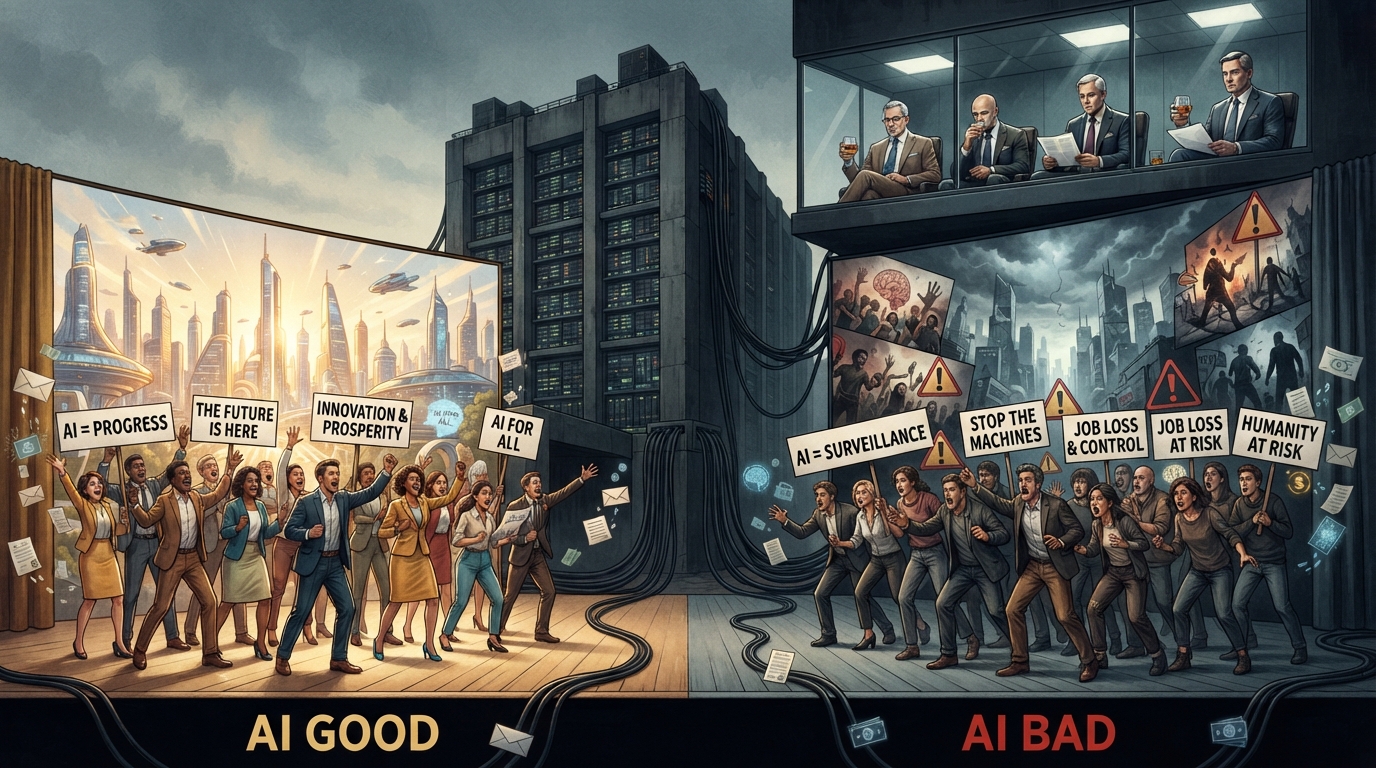
Everyone wants to tell us whether AI is good or bad. The question nobody is paying us to ask is who owns the machinery
I’ve been arguing the case for AI on this blog for a while, and over the same stretch I’ve watched the antipathy towards it thicken. A good deal of that is people looking at the technology, thinking about it properly and deciding they don’t much like it, which is their business and their right. Some of it, it turns out, arrives with an invoice attached.
Sabine Hossenfelder, a physicist with previous when it comes to irritating her own profession, put out a video this week called I Was Offered Money to Tell You AI Will Kill Us. An organisation had approached her wanting to fund a video about AI as an existential threat. She has warned about the dangers of AI herself, so the pitch wasn’t absurd on its face. What stopped her was the small print. They had already written the sentences she was to say and the references she was to cite. She said no. Her point, and it’s the one that sticks, is that the offer doesn’t evaporate when she declines it. It just works its way down the list until it reaches someone whose scruples come cheaper.
The specifics are worth laying out, because they run in both directions. On the worried side, Hossenfelder names the Center for AI Safety, which has been handing out grants to creators making videos about the coming apocalypse, and Control AI, which has sponsored videos on the same theme. The Future of Life Institute launched a campaign called Protect What’s Human in February, budgeted at up to eight million dollars and running in five American states. Part of it invites people to follow the campaign’s directions, submit a draft, take feedback, publish, and get paid. The Washington Post reported that the same institute had funded thirty projects producing AI safety content.
On the enthusiastic side the sums get bigger. In May, Taylor Lorenz reported in Wired that Build American AI, the nonprofit arm of a super PAC called Leading the Future, had a marketing agency offering lifestyle influencers up to five thousand dollars for a single TikTok framing China’s progress in AI as a threat to American jobs and to children’s data. The script came with the money. Some of the resulting posts were tagged as advertising without saying who had actually paid. Leading the Future counts OpenAI’s Greg Brockman, Palantir’s Joe Lonsdale and the venture firm Andreessen Horowitz among its backers, and has been reported as sitting on around a hundred and forty million dollars in commitments.
[There’s a live argument about whether the two sides are spending comparable amounts. Nirit Weiss-Blatt replied to Hossenfelder to say the doomers are well ahead. I have no way of settling that, beyond noting that the figure which gets reported is rarely the whole figure.]
The first rule of Fight Club, or of critical theory, which comes to much the same thing, is follow the money. Reading a news item in 2026 without asking cui bono, meaning who is financially better off for this item being in the world and who paid to put it there, is taking in half the page and calling it the news. When Herman and Chomsky published Manufacturing Consent in 1988, in an age before social media was even a thing, the propaganda model they described needed the resources of a government or a large corporation to operate. The costs have come down since. Social media hands the same machinery to any lobby group with a modest budget and a spreadsheet of creators, and the message arrives in the voice of someone the audience already trusts, which is worth more than a billboard.
[Declaration of interests: I am a one woman multi-media combat unit with a remarkably tiny budget, advocating for the acceptance of AI in written communication so I can popularise my self-published science fiction books of cautionary tales about the use of technology, and yes, the irony keeps me awake at night too.]
As I touched on with the Weathermen piece a few weeks ago, activism of this sort can walk us into dangerous ground. Matt Taibbi set out the mechanism well in his 2019 book Hate Inc., subtitled “Why Today’s Media Makes Us Despise One Another”. His argument is that cable news and online media stopped presenting the news and moved to a consumer model, selling outrage, fear, othering and division in exchange for attention. Issues get drained of nuance and served up as binary positions, and the audience is invited to adopt the posture of a football supporter at a cup final. The algorithm then works out which end you’re standing in and feeds you a diet of self-similar horror every time you log back on, to firm up the beliefs it decided you held. It heightens the emotional temperature, and in an information war, as in any other kind, truth is the first casualty.
Taibbi’s prescription was to make yourself aware of the manipulation, which is sound as far as it goes, but it stops at the individual. Reading the two AI campaigns side by side, what strikes me is how much they agree on. Both want the argument to be about whether AI is a good thing or a bad thing, and that framing has a very useful property for anyone who already owns a data centre. If the technology is going to cure cancer, the people building it need to be left alone to get on with it. If the technology is going to end the world, we need those same people, since they’re the only ones who understand it well enough to fit a leash. Either way the compute stays exactly where it is and the answer comes back from the same address. A binary is a comfortable shape to fund, because both ends of it lead home.
This isn’t the place for a full political argument, and I can’t pretend to be neutral about it. My Marxist sympathies aren’t much of a secret, and they come down to this: AI is too important to be left to the captains of capitalism. The question that decides how this goes is a question about the deeds. Who owns the means of production, in a future where all production has been touched by AI, and what do the rest of us hold in the meantime beyond our own attention.
The camps I can see so far are AI Good and AI Bad. What’s missing is one that says AI is neither, and that ownership settles the outcome. It’s a harder sell. It won’t go on a placard, and it can’t be delivered in under sixty seconds by a lifestyle influencer standing in front of a flag. Nobody has offered me five thousand dollars a video to say it, either. I have checked.