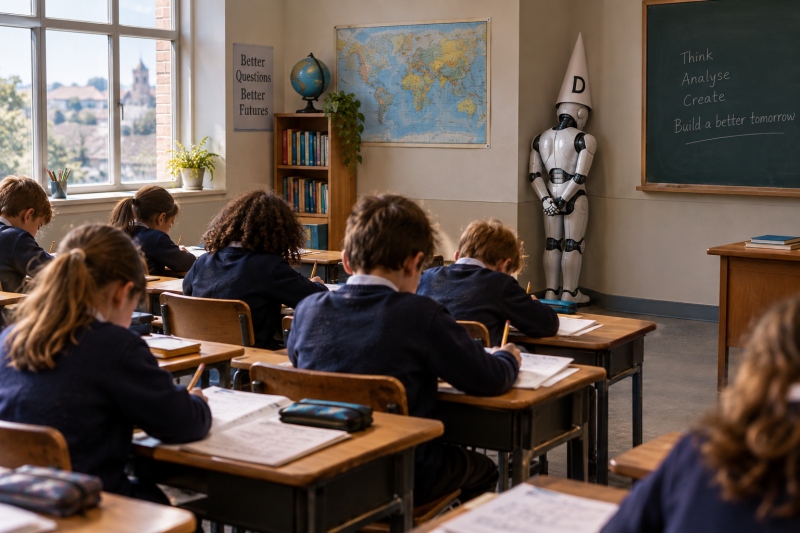
On Chicago’s staff-inclusive AI ban, New York’s moratorium, and why keeping students away from the tool might be the bigger risk
This week brought three stories that, between them, amount to a small skirmish in the war between AI and education. None of them settled anything, but each is worth a closer look.
Most AI policy in education gets written by people who use the tools, for people who are not allowed to. The University of Chicago has done something rarer. Its social sciences core is going analog for the coming year: texts on paper, no laptops, no wearables, no recording the seminar. The clause worth reading twice is the one about the staff. Instructors are covered by the same ban. AI-assisted grading is out unless checked against human marking by hand, and every syllabus has to be written by an actual scholar.
That’s a policy prepared to cost its authors something, which is exactly why it will be harder to dismiss than the usual detector-and-punishment approach so many universities have settled for. It also sits oddly beside the fact that the university signed a contract back in June giving every student and every member of staff a free Claude subscription. One division has, in effect, built a room that the institution’s own tool isn’t allowed into.
Meanwhile, over in New York, nobody decided to put generative AI in front of a seven-year-old. It arrived quietly, folded into a software update, inside products the schools had already bought and paid for. That’s the detail in Mayor Mamdani’s moratorium worth sitting with.
The policy pauses student-facing generative AI from pre-K through eighth grade for a year, covering something like 600,000 children, with exceptions for assistive technology, multilingual learners and a handful of supervised pilots at high-school level. To enforce it, the education department is switching off AI features inside 38 programmes already in use across the system. It hasn’t published the list. Officials have also admitted, with a candour you have to admire even as it makes your eyes widen, that they never established how much AI was running across the system’s 1,600 schools, and declined to release the survey that asked. One publisher named at the press conference has since said its own reading programme contains no student-facing AI at all, which tells you rather a lot about how firm the ground is under this whole exercise.
So the year-long pause is doing two jobs at once. It’s a policy, and it’s the first honest inventory the district has ever taken of what its own software actually does.
All this put me in mind of a bit by the comedian Des Bishop, doing the rounds again on social media, in which he mocks the teachers of his own school years who wouldn’t let pupils use a calculator, because what happens when you’re older and you don’t have one to hand? As he points out, most of us have two now, one in the phone and one on the wrist, and even without those we could just ask the assistant sitting in the room. The audience always laughs at that, because it’s true, and because it exposes something a bit silly in how each generation defends the particular kind of knowledge it happened to grow up needing.
I think the same argument is coming for AI, and for the same reason. Those of us who remember life before it are unusually precious about the facts we’ve stored away, as if the storing were the achievement. But wisdom was never really about how much information you could hold in your head at once. If it were, most systems of government would have collapsed centuries ago.
Buried in the more willowy conventions of the British constitution is the idea of ministerial responsibility. A new minister takes office and immediately assumes full responsibility for every issue currently sitting on their department’s desk, including the ones inherited from three governments back. Nobody expects them to have mugged up on the detail the night before. They are not meant to know it. They are meant to be briefed on it, by civil servants who do, which is what the famous red boxes are actually for. Knowledge gets separated from decision-making by design, because in a sufficiently complicated system that’s the only way the whole thing keeps functioning.
I can imagine a future in which the sheer accumulation of facts matters rather less than it used to, and where the shape you can build around them matters rather more. Thinking becomes less about retrieving detail from memory and more about knowing what to ask, how to ask it, and how to judge the answer. That strikes me as something a school could usefully be teaching right now. If you’ve never quite worked out how to get an LLM to behave differently depending on what you’re trying to accomplish, you are probably not getting your money’s worth out of that subscription.
So when New York announces a ban on AI in the classroom, something at the back of my neck bristles slightly at the thought of people who have not, on the whole, taken the time to master this technology making decisions about a future in which mastering it won’t be optional.
Later in the week I found myself in one of those social-media threads that exist purely to waste an evening, arguing the case against someone insisting that AI rots the brain.
I took the other side. Having access to a large language model, in my experience, is like having a university professor of any subject on call whenever a question occurs to me. Set that against the reality of a classroom today, where a child is lucky to win a sliver of the teacher’s attention amid thirty other raised hands.
I don’t think AI is a cure for what ails education. But a rich resource sitting unused because the adults in the room haven’t got round to understanding it yet still strikes me as the worse of the two mistakes on offer.
Chicago has at least had the decency to ban itself along with everyone else. I’m still waiting for the version of this policy that admits the same thing about the grown-ups making the rules for New York’s seven-year-olds.