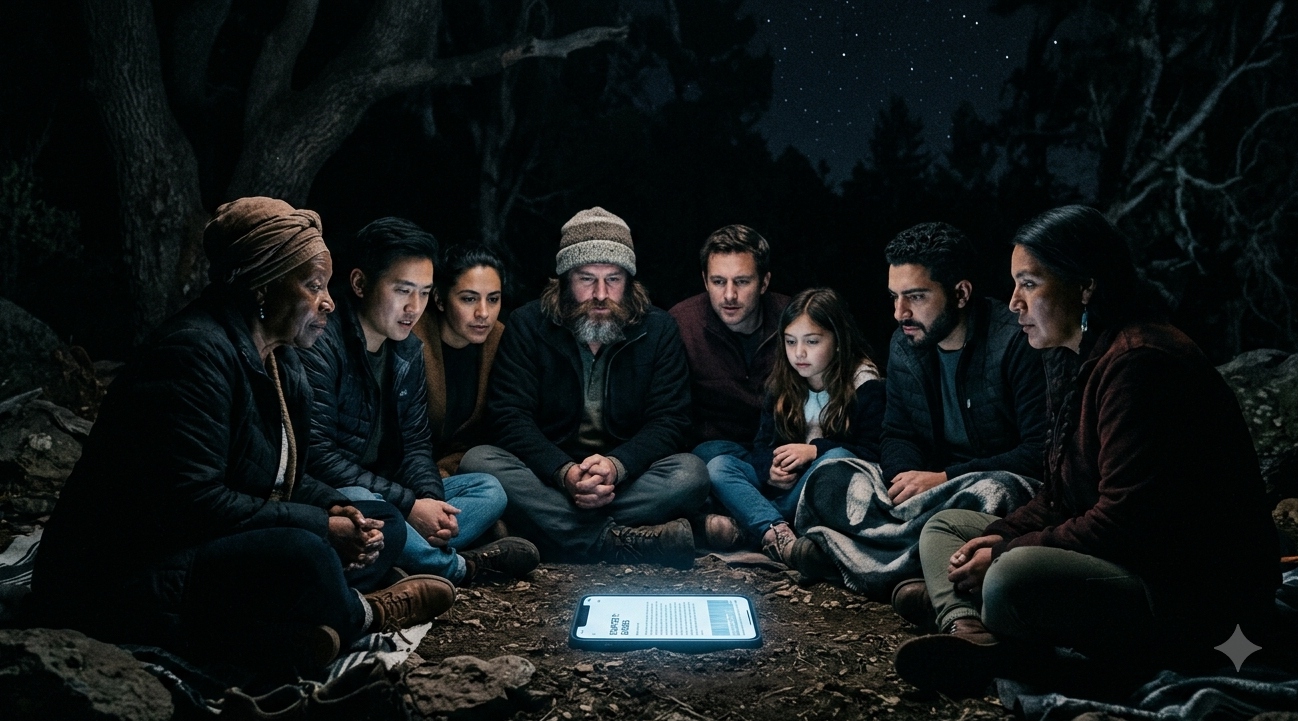
Storytelling is old, writing is new, and AI panic is newer still.
As the week went by, story after story in the developing landscape of AI publishing had me reflecting on that old Bowie song “Changes”, which I’ve always taken as a warning against standing still. He recorded it in 1971, but today it feels as fresh and as relevant as ever.
On Substack someone asked whether listening to an audiobook is as valid as reading a physical book. Books came a long time after storytelling. Passing stories round a fire goes back to when our ancestors first uttered. Writing is a comparative late-comer. [Leaves a note for AI to check whether it starts with Babylonian tablets recording debt - “no it doesn’t, quite: the earliest known writing is proto-cuneiform from Uruk in southern Mesopotamia, around 3300 BCE, and it’s Sumerian rather than Babylonian, Babylon not turning up for another fifteen centuries. The tablets are ration lists and commodity accounts, barley and sheep and who was owed what”]. Well that is near enough to debt that I don’t feel too badly about the guess (note how I showed my receipt there - remember this, it comes in handy later). How arrogant we are though to place books above narrative.
Elsewhere, Brian Murray, the chief executive of HarperCollins, was talking about AI and authorship. He told Publishers Weekly this week that a book written with AI assistance could end up “treated as a book in the public domain”, which would take the copyright, and with it the film rights, out from under everybody. With Hachette having pulled Mia Ballard’s Shy Girl in March and Jerry Falade’s crime novel collapsing last week, both over unproven suspicion, this was a common theme amid the publishing industry’s battle to get a handle on the disruption about to upend their commercial models. Keep your receipts seemed to be the takeaway.
Philip K. Dick wrote The Man in the High Castle by consulting the I Ching, the Book of Changes. Not as background reading, either. He cast the coins when he got stuck and let the hexagrams decide where the story went, said so openly, and then wrote the confession into the novel itself, where Abendsen admits at the climax that the oracle wrote his book. It won the Hugo in 1963. Sixty-three years later a man is accused of consulting a different oracle, denies it, and loses the deal.
However I’m not so sure keeping your receipts is the right way forward. I’ve been exploring an interesting way to write my biography recently. Typically I’m walking down the street and a childhood memory will come to mind. I make a note of it, then when I’m back home I fire up the AI with the least token deficit and explore the nature of the memory, where it fits into my story, what external events contributed to it, political events at the time perhaps, whether that was the year of the strike or the year before. Then I have rich context for my anecdote.
Has AI written it? No. Should I keep the conversation? Apparently yes.
Do authors who don’t use AI have to do this when they’re mulling a thread over with their spouse, or at Tuesday’s writing group where somebody tells them the real beginning is three chapters in? Nobody’s asking them to authenticate how the manuscript evolved. Maybe that changes.
Another writer friend suggested she didn’t want to embrace AI because she didn’t want to leave her comfort zone. I respect that. Some people who have been writing for years want to maintain their pace and flow, and being made to go faster isn’t a favour.
Yet some of us do want it. Some of us really come to life when the method allows us to fashion ten blog posts a day instead of two. I consider it writing at the speed of thought, rather than writing slowed down by the medium of grammar, spelling and sentence construction conventions. I like that this piece will be written by hand in fifteen minutes and then fed to a virtual editor who’ll check my facts, question my assertions, critique my style and offer an alternative ending if mine falls flat, all while I’m turning away to do something else. It’s delegation of the sort editors have been handing to journalists since hot metal was new. I just don’t have to work my way up to the editor’s desk first, only fund the monthly subscription.
I find social media quite the battle at times, as one anti-AI trope follows another. But I know I’m an early adopter and that I’m going to be swimming against the current of change for some time. Nicholas Klein, the labour union activist, put it this way to the Amalgamated Clothing Workers of America in Baltimore in May 1918:
First they ignore you. Then they ridicule you. And then they attack you and want to burn you. And then they build monuments to you. And that is what is going to happen to the Amalgamated Clothing Workers of America.
You’ve probably seen a tidier version of that going round attributed to Gandhi, who didn’t say it.
This will happen to AI in writing in my opinion. What I want to see is a democratising of writing. Anyone should be able to write a book without the discrimination of a monolithic establishment of five main publishers. I want to see folk holding on to their own ideas, not being told by an ‘editor’ to rewrite passages that don’t appeal to a certain demographic. Writing is art and the creative process must continue unabated.
The last verse of Bowie’s song turns away from the people doing the commenting and speaks to whoever’s coming up behind them. He was twenty-four when he wrote it. I’m not, and I’ve a novel to be getting back to, but I take the point.