A novelist’s case for building your own AI writing system rather than buying one off the shelf.
When I decided at the start of 2026 to turn my writing hobby into a business, I did what all good entrepreneurs do: I wrote a business plan. Somewhere between the market analysis and the section grandly titled ‘core USPs’, I ran into a fundamental dilemma. Was I selling books, or the AI writing tools to make the books?
This is the ‘picks and shovels’ question, a trope wheeled out in business schools which holds that the people who made money in the gold rush were the ones selling tools and infrastructure, not the ones panning away in the river. The prospector might strike lucky or might not; the man running the hardware store got paid either way.
I first heard this applied to the Dotcom boom, when it seemed wiser to be a web designer than a conventional business owner buying a website and hoping to be the last man standing when the dust settled. In retrospect, the winner there was Amazon, which not only built the world’s largest online retail business but went on to resell the computing technology that made it happen. (In case you were unaware, a startling amount of the online world runs on Amazon’s AWS cloud infrastructure. The shop became the shovel seller as well.)
As I chewed on all this, I ended up rejecting the picks and shovels approach. I had already worked out that AI can assist the writing process in a plethora of ways, and I’d built my own software to help me write my first pilot novel, The Mayfly Mutiny. But a fundamental problem stood between me and rolling that software out to anyone else: it’s personalised to me. The great advantage AI offers is a made-to-measure working environment, one that amplifies your particular strengths and props up your particular weaknesses. The idea that a one-size-fits-all AI writing assistant can be bought off the shelf and turn you into the best writer you can be is, frankly, a fanciful folly.
So in my business plan I made a prediction: a rapid rise in commercial AI writing tools, matched by a corresponding flood of AI slop. My gamble was to tailor my own tool around the way I actually work, and to build a strong enough brand for Maureen Avis Science Fiction to rise above the slop sea. Whether that pays off in the long term, we shall have to wait and see.
The first part of the prediction, at least, seems to be coming true. This week I came across two AI writing tools for novelists: Creader.io, and the Future Fiction Academy, which I found via its YouTube channel. I haven’t used either, so I’ll refrain from reviewing or critiquing them. Suffice to say, the tools are coming. Perhaps, as in the early days of spreadsheets and word processors, the same battle will play out, with a few big names eventually swallowing the market.
Coincidentally, I’ve just finished Cory Doctorow’s excellent book The Internet Con. His argument, briefly, is that today’s tech giants won their dominance by locking users in and walling interoperability out, and that forcing systems to work together again is how you prise their grip loose. Which has given me an idea. Perhaps I should publish the Document Type Definition I’ve developed for importing and exporting drafts of my book, so that any AI can work on a manuscript in an AI-agnostic way, with no lock-in to anyone’s walled garden, mine included. More on that in another blog post.
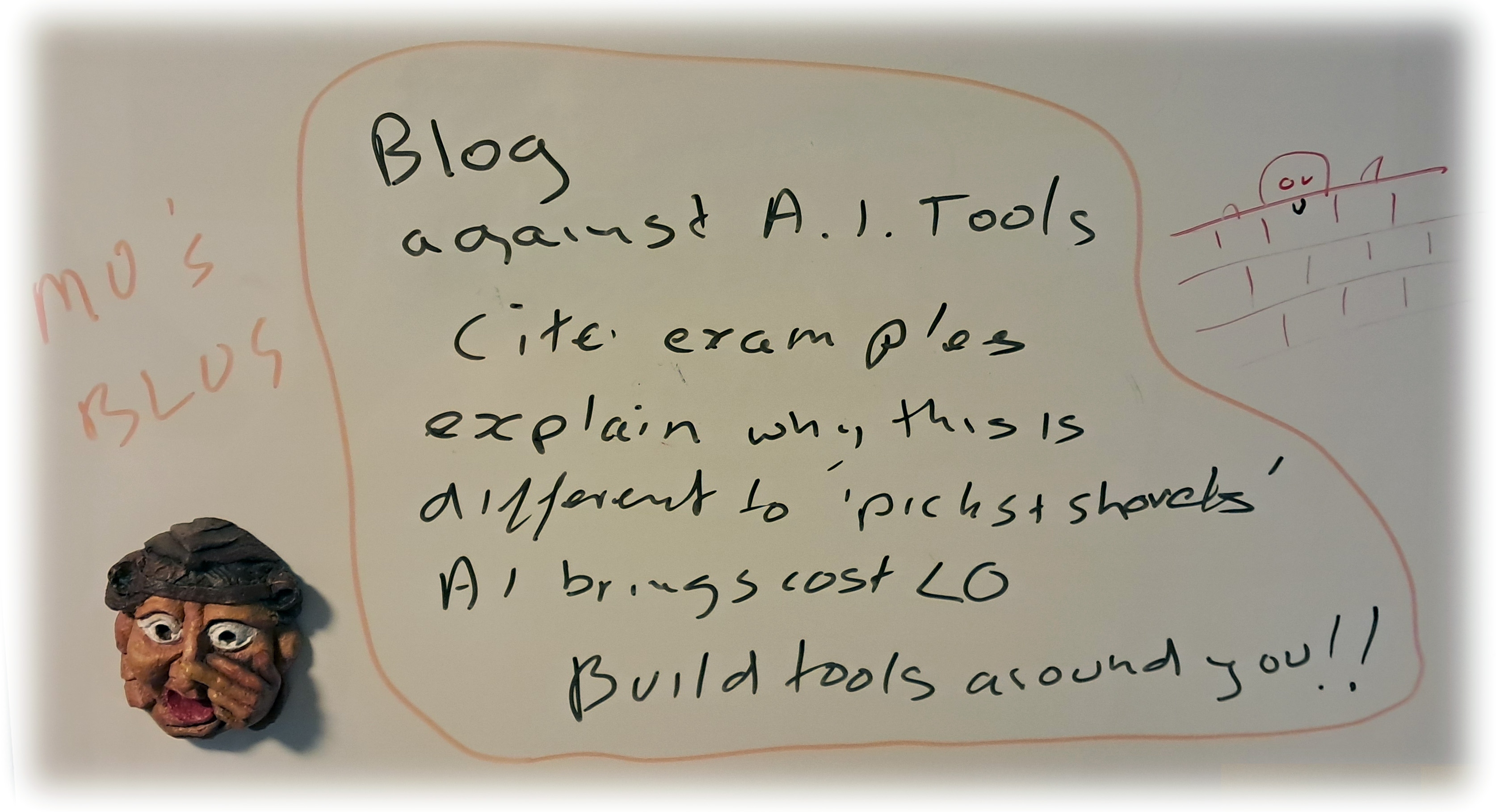
The lead image of this post makes my point about how uniquely we all work. I ‘commute’ between my desk and my kitchen, which I visit dozens of times a day to make tea. On the wall between them I installed a small whiteboard, which acts as a ‘Keep In View’: a place to jot down whatever I’m supposed to be working on, to keep me focused when the desire for a cuppa beckons. Original ideas rarely arrive while I’m sat at my desk. They come to me on walks, when I scribble them into my phone, or while the kettle boils. This very post began that way two hours ago; the photograph shows the exact note I scrawled so I wouldn’t forget it by the time I got back to my desk. That used to happen a lot. Hence the whiteboard.
All humans are unique and we all work in mysterious ways. That’s why I think it profits us more to work directly with a frontier model provider like Anthropic or OpenAI, building our own systems to enhance our writing, than to outsource the job to AI writing software that claims to have solved all the writer’s problems but inevitably forces its own working practices on you. And the economics now favour it: AI has collapsed the cost of building bespoke tools to nearly nothing. Tools like Codex and Cowork are flexible enough already, and their ability to vibecode a specific tool for you, on request, is rather like having your own genie in a bottle. Except you aren’t limited to three wishes, and the genie doesn’t mind how often you put the kettle on.