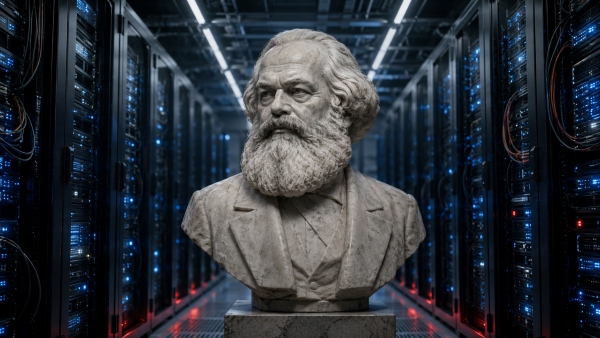
Marx, machine learning, and the struggle over who profits when thinking gets cheaper.
A short video came across my feed this week in which a woman held up a Penguin Classics copy of The Communist Manifesto, which she was reading for the first time, and read out the sentence that had stopped her mid-chapter. It was the passage describing a society that has conjured up such gigantic means of production and exchange that it resembles a sorcerer who can no longer control the powers he has summoned. Marx and Engels meant the factories. She heard something nearer to home, the question of whether we should keep building things, artificial intelligence among them, that might one day think for themselves or fall into the wrong hands, though she was careful to say the quotation was written for a world with no AI in it.
Her wider point was that old books have a habit of turning out to be about the present, and that you do not discover this until you actually read them. Fair enough. But it left me chewing on the more specific question of what the authors themselves would have made of it all. They were, after all, living through a technological convulsion of their own. Factories, railways, mechanised production and global trade were rearranging the shape of ordinary life around them, and they were paying close attention.
Their complaint was never that the machinery was bad. If anything they were rather awed by capitalism’s capacity to generate productive power. What troubled them was that all this power was being organised around ownership and profit rather than around the people whose lives it was busy remaking. And it is hard to revisit that sorcerer now without picturing a data centre humming away somewhere, stacked with borrowed human knowledge and drawing enough electricity to make a small town nervous.
The usual AI nightmare gives the machine motives. A computer wakes up one morning, concludes that humanity is terribly inefficient, and begins plotting our removal from the premises. I am not convinced that is the danger worth losing sleep over. The more immediate one is duller, which often makes it more serious. Artificial intelligence does not need to decide that people are expendable when companies, investors and governments may already be inclined to treat them that way. It does not need a will of its own when it can be deployed by organisations that regard labour, public services and human attention as costs to be trimmed.
Underneath all the talk of clever chatbots, that is the actual economic question. Who owns the machine, who controls its use, and who receives the benefit when it makes work easier?
Because the potential really is liberating. These tools could clear away the mountains of repetitive administration that clog schools, hospitals, councils and small charities. They could help a teacher prepare materials for a class with wildly different needs, make legal and financial paperwork less forbidding, give disabled people better tools for communication, and let tiny organisations do work that currently requires a department they could never afford. For writers and researchers, an unusually patient assistant that will help you untangle an idea at two in the morning without sighing or pretending it has definitely read the book you are talking about.
In a sensible society, those gains would buy us time. Less drudgery ought to mean shorter working weeks, better public services, more room to raise children, grow vegetables, play music, or simply sit in the sun without being accused of failing to optimise ourselves.
We seem instead to be drifting towards a different arrangement, in which the productive power is privately owned, access is metered, every useful thought passes through somebody else’s server, and every gain in efficiency becomes an excuse to reduce payroll or demand that the remaining staff produce twice as much in half the time. None of that is inevitable, but avoiding it requires noticing that it is happening.
Which brings me to the word “token”. A token is merely a chunk of text processed by a language model, and there is nothing sinister about charging for computing power. Servers, chips and engineers do not materialise out of thin air. But the more useful these systems become, the more our work, education and public administration will depend on passing through them, and at that point the price of a token stops being a niche concern for software developers and becomes an economic pressure on everyone.
You can already see the outlines. Anthropic has announced that its top model, Fable 5, comes out of the included allowance on most paid plans after 7 July and moves onto a usage-credit system, billed at the most expensive rates the company publishes. In fairness, Anthropic says this is a temporary measure while it builds capacity, and the model has had an eventful few weeks, having only just returned from a government-ordered suspension. Its newer Sonnet 5 model, meanwhile, launched at introductory API prices of $2 per million input tokens and $10 per million output, which are scheduled to rise to $3 and $15 from September. The company also notes, in the small print, that its newer tokenizer produces roughly 30 per cent more tokens for the same text. The per-token price stays flat while each sentence quietly becomes more tokens. You do not need a conspiracy theory to find that arrangement interesting.
None of this proves that AI is about to become ruinously expensive. It is simply a sign that the free buffet is acquiring a cashier. The cheap, seemingly abundant AI we have grown used to has been partly a product of subsidy, with venture capital and colossal infrastructure spending keeping the apparent price low while everyone scrambles for market share. At some point the invoices have to land somewhere. And when these companies, currently valued as growth stories, eventually have public shareholders to satisfy, they will not merely want a healthy revenue stream. They will need one. That is what shareholders are for. The gentle phrase will be “sustainable monetisation”. The practical meaning may be higher prices, stricter limits, premium tiers, more advertising, and a growing tendency to charge for whichever bits of AI turn out to be genuinely useful.
There is another force at work, though, and it comes largely from China. Chinese model makers have been engaged in a brisk race to make capable models cheaper. DeepSeek recently made a 75 per cent price reduction on its V4-Pro model permanent, bringing some categories of usage down to fractions of a penny per million tokens. Alongside Qwen and GLM, these models are increasingly credible for coding and agent-style work at prices that make the American frontier systems look positively aristocratic. Some are also released with open weights: DeepSeek publishes its V4 weights under an MIT licence, and most of Qwen’s open-weight models use Apache 2.0. Which means an organisation can, at least in principle, run them itself instead of paying permanent rent to a single remote provider.
This is where I need to put a small red circle around the phrase “open weight”. It does not mean public domain, and it does not mean the training data, methods or safety testing are transparent. It certainly does not mean anyone with a modest laptop can run a frontier model beside the kettle. The largest systems still need serious hardware, electricity and money, and the chips, the cloud and the data centres all remain concentrated in remarkably few hands. A downloadable set of weights is not the same thing as a genuinely social means of production.
Still, open weights put a crack in the wall. They make it harder for a handful of American companies to insist that powerful AI must always live behind their particular payment gate, and they give smaller firms, researchers and public bodies somewhere else to stand. That does not make China a socialist fairy tale, and cheap Chinese AI comes with its own questions about censorship, surveillance and state power. Swapping one set of remote gatekeepers for another would not be liberation, merely a change of uniforms at the door. But price competition exposes something useful: the high cost of AI is not a law of nature. It is the product of hardware scarcity, energy costs, market power and strategic choices. Economics, in other words.
And economics is where the argument sharpens. We are heading towards a world in which AI may make society more productive while making many people less secure. A publisher can use it to shrink commissioning budgets, a call centre to make fewer people handle more customers, a gig platform to watch its workers more closely and call this innovation. Here in Britain the BBC is shedding up to two thousand jobs while promising to be faster in its adoption of AI, under an incoming director general lately of Google who talks about the technology giving people special powers.
The comedy, and Marx did say history repeats itself the second time as farce, is that the replacement strategy keeps failing on its own terms. Nearly a third of American hiring managers who cut a role because of AI have since rehired for the same or a similar one, and about one in three employers spent more on the restaffing than the original cuts ever saved. Ford is the instructive case. After leaning on automated quality systems and hundreds of AI cameras, it discovered the machines could not catch the defects a veteran engineer spots by sound and by feel, so over three years it brought in 350 experienced hands, many of them former employees. One vice president admitted, with impressive frankness, that they had mistakenly believed that ingesting the design requirements into an AI would produce a high-quality product. The rehiring worked: Ford now tops the JD Power quality rankings and credits the veterans with saving hundreds of millions in warranty costs. But notice what the returning engineers are actually for. Ford calls them grey beards, and part of their job is to train the AI and the younger staff so that, eventually, their experience will no longer be required. They have been welcomed back to hand over the very knowledge that made them worth rehiring. Marx described machinery as dead labour, which sounds gothic until you watch a company extract a career’s worth of judgement from someone before showing him the door a second time.
The machine saves time, but nobody has yet explained why the time should belong to the shareholders.
The better destination is not to ban the technology or pretend the pre-digital world was a golden age of honest toil and kindly employers. I like these tools. I use them. I have seen what they do for people who cannot afford editors, coders or assistants. But the gains ought to be shared, and that has some fairly concrete implications: public investment in computing capacity so that schools and libraries are not permanently dependent on whichever corporation owns the fashionable model this quarter; support for genuinely open models and standards; rules that give workers a real voice when AI changes their jobs; and a habit of treating the productivity dividend as something that should buy shorter hours and stronger services rather than fatter margins.
It also seems worth remembering where the knowledge inside these systems came from. Books, articles, code, music, research, public records, languages, centuries of shared culture. Nothing descended from the heavens. It is our own inheritance, scraped up, compressed, industrialised and installed in a server rack.
So what would Marx make of it all? I suspect he would have little patience with the spooky-machine framing, and no interest at all in whether the thing might become conscious. He would ask who owns the machinery, who sets its purpose, who bears the risk, and who pockets the extra productivity, and he would spot the contradiction at once: tools capable of reducing necessary labour on a remarkable scale, arranged so that the reduction arrives as somebody’s redundancy notice.
Whether AI gives us more time or simply a new way of paying rent on our own collective intelligence is not written anywhere in the code. It is written in the ownership papers, which make far duller reading than the demo videos. That, I suspect, is rather the point.