What happens to writing after it leaves your hands.
Last week I wrote about prompting, not as a technical discipline but as a writer’s problem. Where does the work begin, and at what point does it stop being mine? That was the question from the inside, the kind a writer asks at her own desk, before anything has left it.
This week I have been thinking about the same problem from the outside. What happens after the words leave you?
A sentence used to leave the writer and go looking for a reader. Now it may need papers. Once it is published it can be cited, scraped, summarised, licensed or sued over, and at every stage it drifts a little further from whatever you meant by it. The writer has rather less say in this than she would like, which is to say none.
Last week’s was the inside-name question: what a writer calls her own process. This week’s is the outside-name question: what the world calls the work once it is out of her hands. Original or derivative, human or machine-made, a novel or “training data”. The work does not get to choose. It gets renamed at every border it crosses.
A prize and a second story
The thing that brought this into focus was the Granta-Commonwealth Prize controversy reported by The Hindu. A short story won a prize and was then questioned as possibly AI-generated.
I have no verdict to offer on that particular case. AI detection is unreliable, and literary pile-ons rarely bring out anyone’s better nature. What interests me is what the accusation does to the reading.
The story acquired a second story. There was the thing on the page, doing the ordinary delicate work of fiction, and then there was the question hovering over it like a courtroom sketch: did a person write this. The second story tends to eat the first. Once the accusation is in the air the reader stops reading and starts inspecting. A clean phrase looks suspiciously clean. A smooth transition looks too smooth. Competence itself starts to look like a confession.
Writers used to worry about sounding amateurish. Now some of us worry about sounding too polished, too balanced, too obviously capable, which is a strange thing to be afraid of. The old anxiety was whether they would think you any good. The new one is whether they will think you were there at all.
The human receipt
This has produced an odd new demand. Not legal proof, not yet, but a sort of social proof. Show us the drafts, the crossings-out, the evidence that a person sweated over this.
Writers have always had to earn a reader’s trust, even when the mind behind the page is unreliable or invented or in disguise. Fiction is organised lying in the service of truth, and the reader signs up for it knowingly. What has changed is the worry that there may be no mind behind the page at all, only a very good average of everyone else’s.
This is where “AI slop” comes in, a phrase that is both useful and a little dangerous. It is useful because there is a great deal of slop about. You have seen it: articles that read as though they were poured rather than written, recipes nobody cooked, the occasional warm biography of a person who never existed, books that look assembled from the literary sweepings under the internet’s fridge. Readers are right to resent it, and so are writers. It clogs the channels real work has to move through.
The danger is that “slop” becomes a lazy way to dismiss work without reading it, a fresh sort of gatekeeping aimed at anyone whose prose does not match what the accuser imagines real writing sounds like. The trick is to defend human writing without turning every reader into a border guard and every writer into someone sweating at passport control.
Courts ask colder questions
In the actual courts the question is different, and a good deal colder. The Thomson Reuters v Ross Intelligence case is not asking whether a paragraph feels human. It is asking what kind of use it is when copyrighted material is fed into an AI system, and whose market that use damages.
So you have two questions that look similar and are not. Public opinion asks whether a machine wrote this. The law asks what was copied, how it was used, and who lost money by it. One is about trust, the other about rights, and writers are stuck between them.
We would like to be paid, obviously; being paid is a charming old tradition I am keen to preserve. But we also want the work to keep its name. We want a poem to stay a poem rather than become an “input”, and research and journalism and fiction to be treated as made things rather than ore lying about waiting to be dug up. The language matters because the language is where the shrinking starts. Call a book “content” for long enough and someone will ask why content cannot simply be generated on demand. Call writing “data” and someone will ask why it should not be mined.
Reading for extraction
Then there is the newest reader of all, which is not a reader. Two pieces I came across this week, both at AI Journal, described the rise of so-called Answer Engine Optimization, a phrase with all the polished chill of a hotel lobby.
Search engine optimisation was already a peculiar bargain. Writers learned to shape their work so Google could find it and rank it, which sometimes made things clearer and sometimes made the whole internet read as though it had been written by someone trapped inside a spreadsheet. Answer Engine Optimization goes a step further. The thing being written for is no longer the reader, or even the search result, but the system that will process the page, lift the answer out of it and hand a summary to a person who may never see the original.
The chain runs roughly: writer, publisher, crawler, model, answer engine, summary, reader. The work is handled at every link, and something falls off at each one. Voice usually goes first, then the qualifications and the doubts, then the small stubborn oddities that made the prose belong to anyone in particular.
None of this is all bad. I use summaries; you probably do too. A summary can be a useful map. The trouble starts when the map quietly stands in for the journey and nobody goes to the village again.
It does change who you imagine you are writing for. You might still picture a person with a cup of tea and a cat and a half-charged phone. But the first thing to handle your sentences may now be a system that has no use for the pleasure or the surprise, only for the answer it can lift out. A lot of online prose already reads as though it were written to survive that process rather than to be read, which is its own small sadness.
Refusing the flood
Some publishers are trying to hold a line. The CBC reported this week on a Halifax publisher refusing AI-generated books, betting that readers have had enough of the sameness you get when books are produced at volume without anyone having to mean anything by them.
I sympathise. I also think the line is harder to draw than anyone wants it to be. One writer uses AI to brainstorm titles, check continuity, argue with a weak paragraph or summarise a stack of research. Another presses a button and publishes the literary equivalent of instant mash. Treating those two as the same act is silly; treating the difference as unimportant is also silly.
The useful question is not whether a tool was used. It is whether there is an accountable person behind the work. That word, accountable, is the one I keep coming back to. A writer can be asked why this word and not another, why this scene is here, why the argument turns where it does. She may answer badly, or not know the answer until much later, but there is someone there to ask. With slop there is usually no one there, only output. And output and creation are not the same thing, whatever the market reports would prefer.
Kafka gets a chatbot
Cory Doctorow had a nicely grim phrase this week, “Kafka-as-a-service”, for the way these tools make it cheap to generate forms and workflows and automated nonsense at scale. It stuck with me because it points at something larger than paperwork. We are building a world in which everything has to be processed first. The complaint, the job application, the school essay, the novel waiting on submission: all of it has to enter a system and be classified and made legible to software before anyone treats it as real.
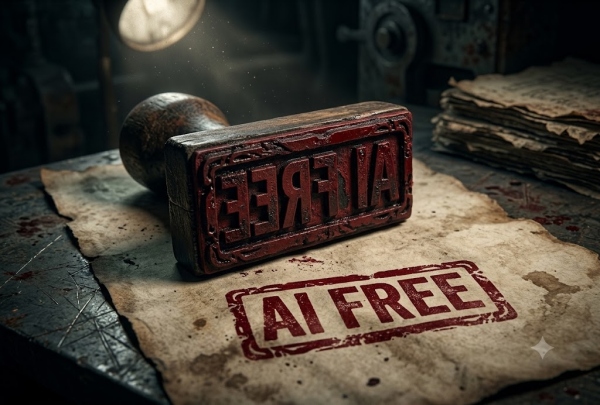
Writing is not exempt, and may be where you notice it soonest, because writing already comes wrapped in labels. Genre, category, metadata, rights, provenance. The risk is that the label starts to matter more than the thing it is stuck to. Was AI used, is it compliant, is it optimised, is it discoverable. Some of those questions are necessary. But a culture that only ever asks administrative questions about art will, in the end, get administrative art: stamped, filed and a little dead behind the eyes.
The same weather
The big business story of the week was SpaceX and the talk of an enormous IPO, with the Financial Times writing about Starship and Starlink and Mars and, somewhere in the investor decks, the idea of putting data centres in orbit to run AI. A fascinating story, and not really mine this week. What strikes me is how fast the language of AI has climbed out of the computer and attached itself to everything else: rockets, courts, search engines, copyright tribunals, even the local planning row. It has stopped being a tool you pick up and started being something more like weather, and weather is hard to opt out of.
Which is the whole reason the chain of custody is worth caring about. Not so writers can retreat into purity, or pretend the tools are not there, or insist that every sentence arrive unassisted by spellcheck and dictionaries and editors and strong coffee and panic. Writing has always been assisted and always been social; it has always borrowed and answered and argued back. But it still needs a witness. Someone has to be answerable for the sentence.
After the words leave
So what do we actually do.
Writers can be more honest about the process and keep the evidence of it: the drafts, the notes, which bits came from research and which from invention and which from an argument with a machine at one in the morning. Not as a defence exhibit, just as ordinary practice. Don’t use the tools to fill the gap where a thought ought to be, and don’t sand off every trace of having been alive while writing it.
Readers have the harder job, which is scepticism without paranoia: resisting the slop without becoming a lazy accuser, noticing when a piece has no pulse while remembering that an unfamiliar pulse is not the same as a mechanical one.
Publishers and platforms carry the most, and cannot simply hand the judgement off to a detection tool, a terms-of-service box, or whatever classifier is cheapest this quarter. If they want to be trusted they will have to act in trustworthy ways, which means clear policies, actual human judgement, and the humility to admit the whole thing is a mess.
The courts will settle the questions about training and market harm and fair use, and those rulings will shape the conditions everything else gets made under. But they will not answer the question underneath, which is who gets to name the writing. That one belongs to all of us.
Last week I asked when a writer can still call the work her own. This week I am asking what happens when the world answers back. After the words leave you they start a second life, travelling through readers and rumours and systems and courts and machines, and getting renamed at every stop. You cannot follow them and keep them safe; no writer ever could. You can only make sure there was someone home when they set out.