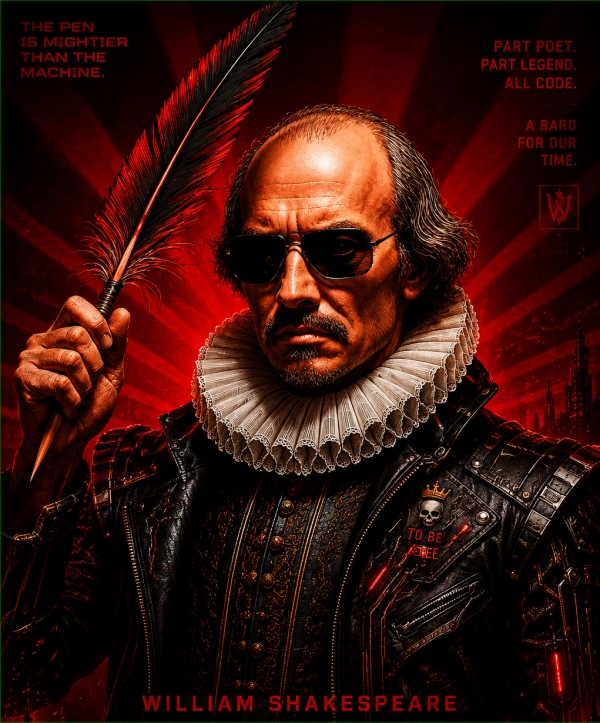
Whether 'tis nobler to suffer the blank page…
This week I found a writer on TikTok who openly admits to using AI, which in author circles is still about as common as rocking-horse shit.
That phrase stays where it is. I’ll come back to why.
The writer is Katri Manninen, a Finnish screenwriter who posts as @katrifromfinland. By her own account she has spent a long time in television, film and publishing, and is now a doctoral student looking at AI and writing, so she is not some chancer who found ChatGPT last Tuesday and declared herself a novelist. What caught my attention was not that she uses AI. Plenty of writers do, though most of them mention it the way you might admit to a minor shoplifting offence. What interested me was where she draws her line.
Across a run of short videos she talks about using AI for more or less every practical part of the job except the one that matters most to her, which is the original idea. She is not asking the machine to dream for her. She uses it after the dreaming is done.
I find that distinction useful, because there is a world of difference between treating AI as a vending machine for plots and treating it as a slightly over-eager assistant. If I already have an idea, a voice, a mood, a half-built scene, then the machine can be a way of prodding the material. That is not the same as laundering laziness through a chatbot.
One of her uses stuck with me. She generates storyboards to go with her scripts. That is not cheating, it is sensible. Film and television are visual. A writer who can put even rough visual references in front of a director is offering something to argue over, not replacing anyone. Nobody ever decided that a sketch on the back of an envelope threatened the future of cinema, and I don’t see why a handful of AI storyboard panels should be treated as the work of the devil. It is something I am planning to try myself.
The fear is understandable. Writers have not had a restful decade. The internet broke publishing and handed the pieces to Amazon. Social media taught everyone to skim. Streaming ate the economics of television. Now AI turns up claiming it can knock out a novel by Tuesday. No wonder people are jumpy.
In the same week I came across the AI policy page from the Alliance of Independent Authors. My first reaction was that it looked nervy, possibly anti-AI. Reading it properly, it is more sensible than that. ALLi suggests independent authors put a short AI policy on their websites explaining how they use the stuff, and it sorts authors into three loose groups: AI-minimal, AI-assisted and AI-integrated. The line I liked was that the group you choose matters less than whether you are honest about it and decent about other people’s choices. That seems about right, and it is a good deal less obnoxious than most of the anti-AI noise in the trade, if only because it is actually addressing the question rather than shouting at it.
I would not want a little “contains AI” label stuck on every paragraph, but I can see the case for transparency. If a book has been substantially generated by a machine, readers deserve to know. If AI was used for proofreading, research summaries, cover mock-ups, blurb variations or storyboards, then we are in greyer and more interesting territory. The question stops being “was AI used?” and becomes “what did the writer actually contribute?”
That is the real question, because a writer is not a typist who happens to be in a good mood. A writer chooses what matters, notices the odd detail, carries grudges and half-remembered songs and one peculiar incident involving a bus stop in 1997. A machine can assemble language. It cannot know why your Auntie Joan kept a screwdriver in her handbag, unless you tell it.
This is why trying to catch AI by its verbal fingerprints is both tempting and doomed. Wikipedia has a long and rather enjoyable page on the signs of AI writing. It notes that certain words became badges of particular models: “delve” was the famous one during the GPT-4 period, along with “intricate”, “pivotal”, “underscore”, “tapestry” and “testament”. It also warns, sensibly, that these are not tests so much as suspicions. People used all those words long before ChatGPT existed, and the models change their habits anyway.
The funny part is what this does to the rest of us. Once everyone knows the tells, human writers start avoiding them. People who genuinely like a particular punctuation mark feel guilty using it. People who naturally write in tidy threes start breaking their lists up on purpose. Someone online joked that if she were ever accused of using AI, she probably wasn’t swearing enough. Which is partly why my rocking-horse shit is staying put.
There is a confession buried in all this. A few weeks ago I wrote a post about an evening’s losing battle with passwords, passkeys and two-factor authentication, the whole modern liturgy of proving you are not a robot. I presented the idyllic setting in which I found myself, then shattered it with the line, “Then I lost my presence of mind.” I did not invent that. I took it, knowingly, from Gerard Hoffnung. In The Bricklayer’s Lament the wretched builder reaches the point in his letter where he writes, “It was at this point that I lost my presence of mind.” I have carried that line around in my head for decades, and out it came, barely altered, in a blog post of my own.
There is the real point. When a human reaches for a phrase, we usually reach for the one phrase we happen to have lodged in memory. We do not have a thousand alternatives fanned out in front of us. The machine, oddly, does. It is choosing from a vast spread of weighted possibilities, most of which we will never see, which is exactly why its output can feel smoothed and averaged. So the lazy charge that AI is just a parrot stitching together other people’s words misses something. A human doing the same thing is often the more naked plagiarist. We only have the one parrot, and it only knows the lines it grew up with.
None of which means the worry about AI is misplaced. There is a moral difference between a writer choosing to use a tool and a corporation absorbing the work of millions of writers into a product without consent or payment. The publishing world is starting to draw that line in ink. The Authors Guild in the United States set up a “Human Authored” certification, while still allowing AI for things like spell-checking and research. The Society of Authors here has done something similar. Penguin Random House has begun adding wording to its books stating that the text may not be used to train AI systems. Authors, in other words, are no longer only worried about using AI. They are worried about being used by it, and that is a separate fight worth having.
So I understand the anger, and I share a fair bit of it. But I don’t believe the future of writing is a clean split between the noble human quill and the dirty robot keyboard. Writers have always used tools. Pens, typewriters, dictionaries, spellcheckers, search engines, beta readers, editors, and that strange hour at two in the morning when a cup of tea seems to hold the answer to chapter seven.
AI is another tool, just a stranger one, because it talks back. Used badly it will produce more books nobody needed and more articles nobody reads. It will tempt insecure writers to sand off everything that made them worth reading. Used well it can help a dyslexic writer wrestle a sentence into shape, help a screenwriter see the rhythm of a scene, or act as a sounding board when there is nobody else in the room. It is even useful when it is wrong. A bad suggestion can make you shout, “No, she would never do that,” and suddenly you know exactly what she would do. The machine hasn’t written the scene. It has irritated it out of you.
For the writers alive now, this will stay contentious. Some will embrace it, some will reject it, and a good number will reject it loudly while quietly using it to write their blurbs. The children growing up with this will see it differently. To them it will not feel like an invasion, it will feel like part of the furniture, no more remarkable than deleting a paragraph without retyping the whole page. The argument will move somewhere else.
And the question will end up where it always was. Not “did you use AI?” but “did you have anything to say?” That is the old question, the brutal and useful one, and no machine is going to answer it for you.
So, to prompt or not to prompt. Prompt if it helps. Don’t if it hollows you out. Use it for the scaffolding, the lighting rig, the tedious jobs and the second pair of eyes, but keep your hands on the thing itself. To mangle JFK: ask not what AI can do for you, ask what you can do with AI. And then, for God’s sake, read the bloody output before you publish it.
Sources: Katri Manninen; Alliance of Independent Authors AI Policy; Wikipedia: Signs of AI Writing; AP News: Authors Guild Human Authored certification.