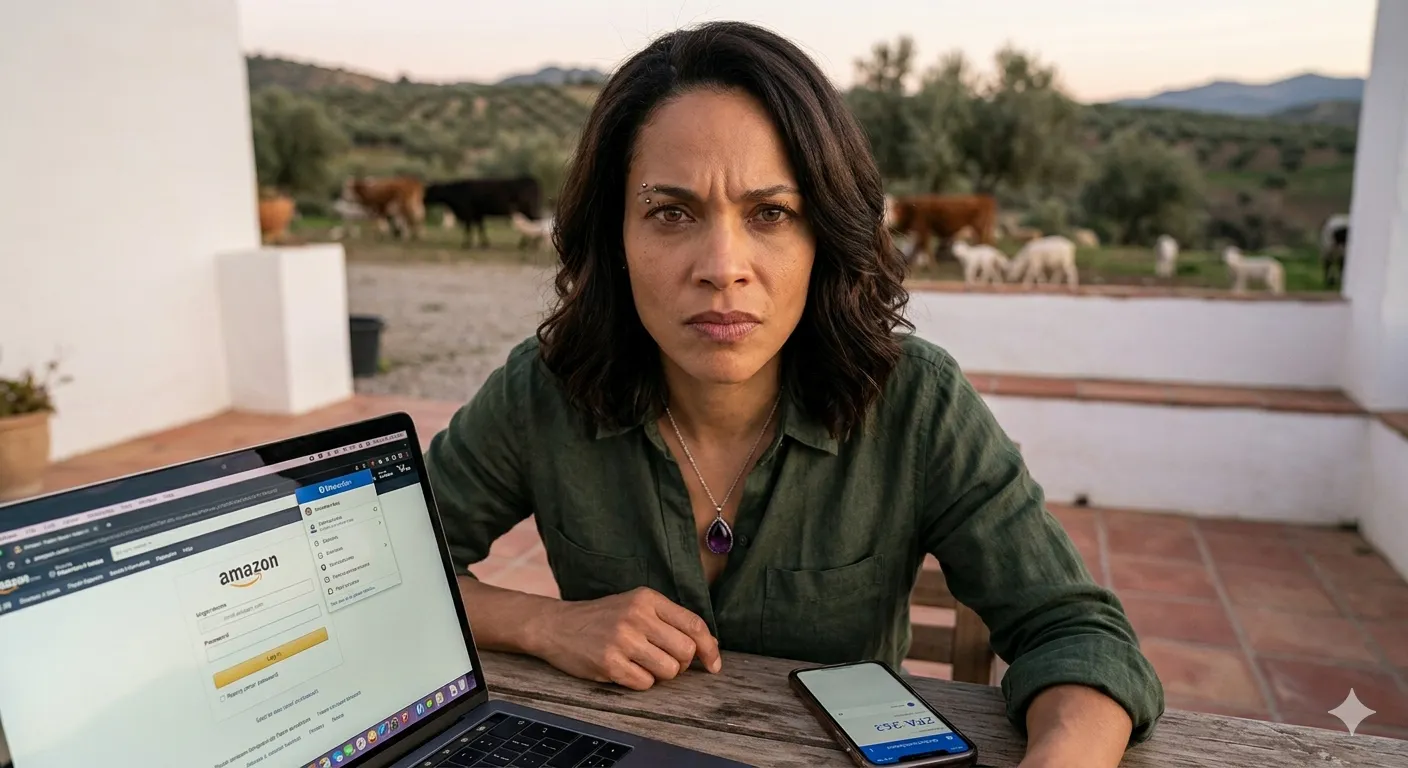
An attempt to follow an author on Amazon turns into a small Greek tragedy about passwords, passkeys, and divine obstruction.
It’s such a pleasant evening where I’m staying, in a little country house in Andalusia, Spain. Dogs are barking in the distance, I hear the human-like voices of young lambs calling to their mothers, and a never-repeating melody as cowbells blend with wind chimes in the gentle evening breeze. It really is idyllic.
Then I lost my presence of mind. I decided to check the Internet.
With a 10 Mb/s connection, so effectively nada, I followed a link to a book by my friend Bruce H. Joffe, continuing a conversation we’d been having earlier in the day. As a courtesy, I clicked the button to follow Bruce as an author on Amazon. That’s when it got nasty.
Normally I’m in the electronic comfort of my office, where cookies are accepted everywhere I go. Here, out in the wilds with a relatively new laptop, the Internet Gods decided to avenge my usual complacency.
I wasn’t logged in to Amazon, which offended Janus, the god of door frames. “Not on my watch. You need to transition to an authenticated state to do that, you puny user.” So I clicked on login and opened my password manager, Bitwarden, an adoption forced on me long ago when the goddess Minerva stole my memory, compelling me to relocate my credentials to an online vault.
Bitwarden had remembered my email but not my password, so I couldn’t log in. Fortunately, I have a file hidden away in a secret location with the Bitwarden password squirreled away for emergencies. It’s about 15 characters long, so I can never remember it. Great! Password accepted.
But wait: Hephaestus, master of the forge, had quoted Goethe at me eons before: better the hammer than the anvil. You need two-factor authentication. So now I had to reach for my phone and pull up the Google Authenticator app (in which I had to type my four digit pin for access!). The timer next to the Bitwarden code was at 10 to 12, so I knew I wouldn’t be able to type that one in fast enough, so I waited for the clock to hit 12 for the code to reset. I could hear Chronos laughing while I copied the new code into Bitwarden.
But now Bitwarden was primed, and a fleet of Amazon identities for different logins dropped down for me to triumphantly select “fill” on the correct one. However, Janus returned. “Before I simply let you in, you feeble pleb, there’s something you must do.”
At some point I’d been bothered by two more gods. Phobos had tapped me on the shoulder: “People get hacked.” Deimos added: “…and you won’t see it coming.” So I’d set up an extra level of authentication on Amazon and was now regretting it. My previously serene evening was turning into a full-on red-mist battlefield. I couldn’t even remember doing this or how. I somehow cajoled the system into sending me a text to my phone with a code number that I entered and was accepted, and I thought I was done.
But oh no, the gods weren’t finished with me yet. Tyche, the goddess of fortune, chance, and destiny, had to show up and throw a spanner in the works. Another drop-down opened in the browser’s Bitwarden extension, inviting me to overwrite the passkey.
What do I do? What if overwriting the passkey creates the same turmoil back in the office that I’ve just spent ten minutes enduring here? That’s what really pushed me over the edge, wondering when it became so unreasonably complicated to click on a follow button. When did we decide it was acceptable for these ever-accumulating slivers of our time to be frittered away on cybersecurity? And cui bono — who benefits from all this? Follow the money, I’d say: the same people who make us click on the image with a crosswalk to prove we’re not a robot.
Anyway, I declined to save the “new passkey”, clicked the button to follow Bruce, nearly forgetting why I’d embarked on this pantomime in the first place, and sat down to write this blog.
Writing is cathartic, so they say, but my heart is still beating at 160 per minute.